Hiking Jiuyangping
I have long heard that Jiuyangping is one of the top ten most beautiful ancient forest roads in Hangzhou and a good place to watch azaleas, so I took advantage of the Qingming leisure time to drive there.
Jiuyangping is located in the mountains of Xindeng Town, Fuyang. You can drive directly up the mountain road. Since it is mountain climbing, I chose to start from Langjiawu at the foot of the mountain and hike up the mountain.
Drive along the Xianghe-Langjiawu village road to the parking lot near the Langjiawu Earth Temple. Follow the signs and go up the ancient road, passing Yinmajian and Guishigu. Go up the mountain from the direction of the Stone Great Wall. After passing a few zigzag paths, you will see a piece of straight up and down, smooth and flat boulder, which the locals vividly call the Stone Great Wall.
Walk along the mountain road next to the Stone Great Wall for 10 minutes, and you will arrive at Jiuyangping. Jiuyangping has no special features and no cultural relics. It is just an ordinary small mountain village. The legendary ancient houses of the Ming Dynasty are only left with some broken walls. The dilapidated ancestral hall in the village hangs the “Zhang Family Ancestral Instructions”. Presumably, the Zhang family used to live here. Looking closely at the ancestral instructions, they are nothing more than exhortations to teach children and grandchildren to be good at farming and reading, and not to steal or be lewd.
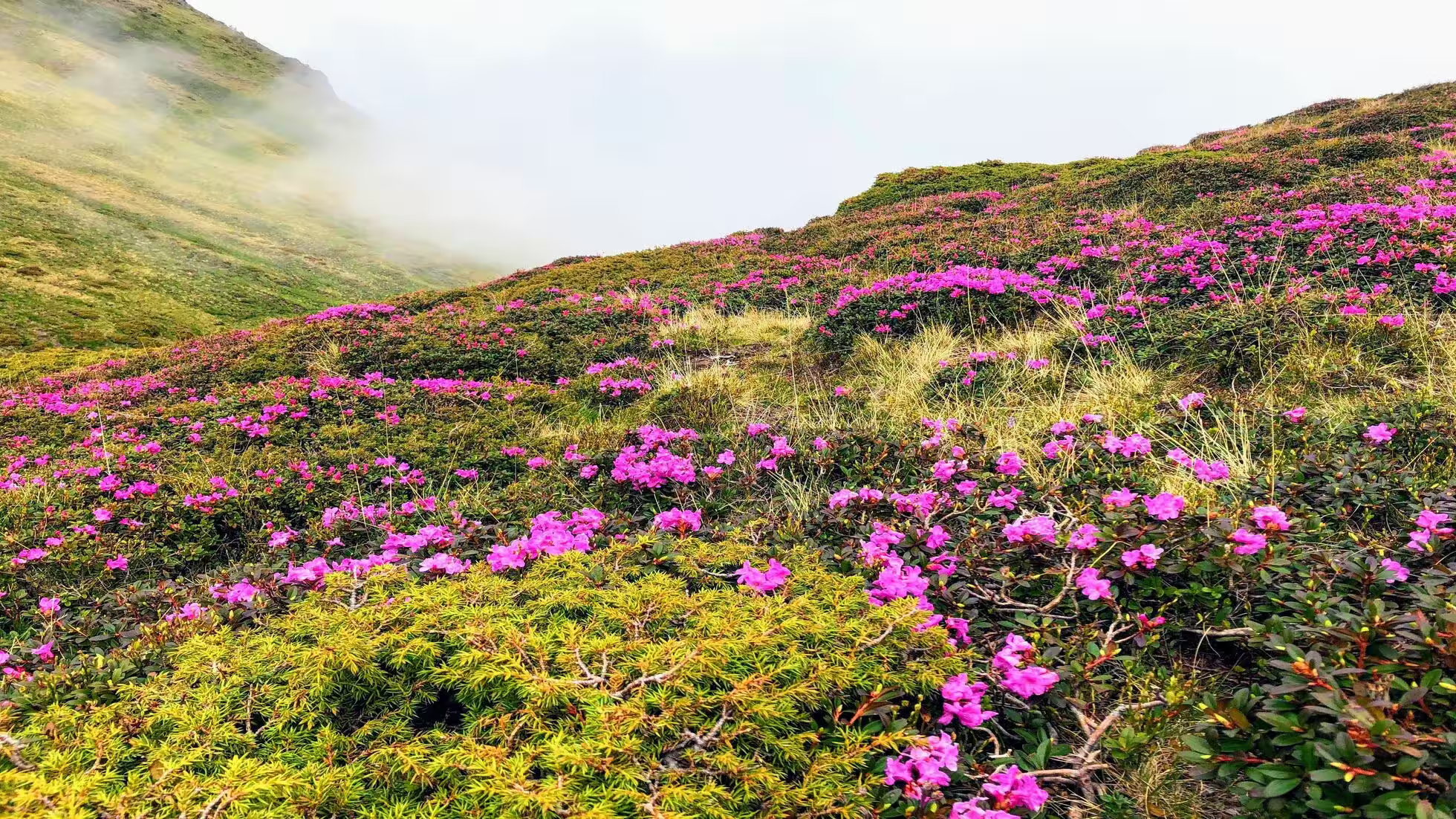
Behind the village is Tangfengjian, the second highest peak in Fuyang with an altitude of more than 700 meters. It is the season when azaleas are in full bloom. Patches of azaleas dress up Tangfengjian very coquettishly. Climbing to the top of Tangfengjian, all you can see are green mountains, vast and mighty.
Jiuyangping has few highlights in terms of natural scenery or cultural atmosphere. If there is any special feature, it is the Torreya trees here. Torreya trees over 250 years old can be seen everywhere. These Torreya trees have been planted since the Qing Dynasty and are still creating income for local villagers today. It is truly a case of predecessors planting trees and descendants enjoying the shade.
Speaking of this trip to Jiuyangping, the oldest tree I saw was the King of Ginkgo in Jiangnan. These two ginkgo trees are located at the head of Xiangxi Zhang Street. They are known as thousand-year-old trees, but their actual age is 960 years. An aunt from the village guided us very enthusiastically. As she walked, she said that the ginkgo trees are just growing small leaves now. The best viewing season is in October. The ginkgo leaves are golden. Many people come to watch every year. Too many people came last year, and the police closed the road. She almost couldn’t return to the village. Fortunately, she took a Douyin of the ginkgo before going out. She took out her mobile phone to show us the video she took, which was indeed beautiful. Then she asked us to follow her Douyin account. She will post ginkgo updates every day. When the ginkgo leaves turn yellow this year, she will invite us to come and watch again, ^_^. Another vivid example of predecessors planting trees and descendants enjoying the shade…
Thinking about it carefully, the oldest tree I have seen so far is undoubtedly the giant sequoia specimen given to China by Americans in 1997 in the National Science and Technology Museum. The giant sequoia grew in 571 BC (the year Laozi was born) and died in 1979 AD, living for 2550 years.
During this trip to Jiuyangping, I saw many villages named Wu and Ping on the road. One knowledge point I learned is that these village names follow a pattern and are not chosen randomly. Villages on the top of the mountain or on the gentle slope of the mountainside are called Ping, while those in the mountain recess or canyon are called Wu. For example, the starting point Langjiawu is located in the valley at the foot of the mountain, and Jiuyangping is located on the gentle slope of the mountainside.
The round trip from Langjiawu to Jiuyangping to Tangfengjian is 7.6 kilometers, and the hike takes about 3 hours. There is a small shop in Jiuyangping where you can resupply and rest.
Published at: Apr 4, 2021 · Modified at: Dec 12, 2025